
A-Z Jargon Buster
These are the main terms that you might see or hear mentioned at orienteering events. There are also many geographical features and terms that refer to techniques used in the sport. These are best explained by experienced orienteers – so join a club and/or enrol on a training course!
Terms are listed alphabetically. You can download a copy as a PDF by clicking here.
| Term | Description |
|---|---|
| Age group | Age groups exist so that everyone can compete against others of similar age. For adults, from age 35, age groups go in 5 year bands, and there is one each for men (M) and women (W). Thus a man aged 50 would normally run as M50, and a woman aged 39 would normally run as W35. The open age categories for adults are known as M21 and W21. Age groups for juniors are in 2 year bands from 10 to 20, though in most events juniors can choose the standard at which they wish to compete. |
| Area | Term used specifically to cover the (usually fairly small) area covered by the map for a particular event. Also used to indicate a group of clubs in a geographical region, eg. West Area. |
| Badge | Badges are awarded for achievement of particular standards. These are usually known as Regional events or National events. Badges can be obtained from British Orienteering or via your club. You can also get SOA badges when you achieve a particular standard in colour coded courses. |
| Bearing | Many experienced orienteers use a compass to take a bearing so they know which direction to go. But you can start orienteering without being an expert with a compass. |
| Bl | Blue course, see colour-coded. |
| BO or BOF | British Orienteering Federation - the British governing body for the sport. |
| BOC | British Orienteering Championships |
| Br | Brown course, see colour-coded. |
| Brikke | (pronounced "brick") - the electronic gizmo carried by participants in an event using Emit. The funny spelling is because the word originated in Scandinavia. |
| Championship | Top level competition, often for a particular set of people, eg. Schools Championships, North Area Championships, Scottish Championships. You don't have to be a top-notch orienteer to take part though! |
| Checkpoint | Also known as a control. |
| Check station | A special box of electronics at the start, in which you check that your dibber is OK. Applies only to events using SI. |
| Circle | Each control site is marked on the map with a circle, usually 7mm across. When you are close to the control, you might say you are "in the circle". But you still might not see the control immediately! |
| Classic | The standard, long-ish distance event, held in countryside of some sort. |
| Clear station | A special box of electronics which clears previous data stored on your dibber. The clear station is usually placed prominently on the route to the start. Hold your dibber in it until it bleeps 2 or 3 times. Applies only to events using SI. |
| Closed event | An event or competition which may be entered only by particular people; eg. an event just for schools. |
| Closing date | The last date for acceptance of entries. This applies only to those events that you have to enter in advance. |
| Code number | See control code. |
| Colour-coded | Colour coded courses us a particular colour to indicate length and difficulty, and these should be consistent from one event to another. The usual courses are: White: easy and short; all on paths or tracks. Yellow: slightly less easy, and a little longer. Orange: not all on paths, and longer again. Light green: navigation skills needed; longer again. Green: the shortest technically difficult course. Blue: technically difficult, medium length. Brown: technically difficult and long. Black: even more so (only found infrequently). Some events link a specific colour to particular age classes. |
| Competition | Usually just another word for an event, though sometimes a competition comprises a series of events. |
| Contour interval | The distance between heights shown by contour lines - usually 5m, but check on your map. |
| Contour only | Some events offer a special map which shows only the contours of the lad (not the vegetation, paths, streams etc.). This makes navigating more difficult, but is excellent practice. |
| Control | Each point marked with a circle on the map, which a competitor is required to visit. Controls are usually marked by a flag or kite, and have a means of proving that you've been there - usually an electronic unit. |
| Control card | Before the days of electronic punching, participants would mark a card with the pin-punch at each control. Now rarely used. |
| Control code | The unique code that identifies a control; usually 2 or 3 numbers. Sometimes referred to as the number on the control, but of course this is different from the control number. The control code will be clearly visible on the control, and you should always check the code of each control to make sure it really is the one you are looking for. |
| Control description | The description of the feature where the control is placed. |
| Control description sheet | The list of controls that comprise your course. |
| Control marker | See flag. |
| Control number | The sequence number of a control on a course - 1, 2, 3 etc.. Not to be confused with the control code. At most events you must visit controls in number order. |
| Controller | The person who has ultimate responsibility for the fairness and safety of an event. |
| Course | When you take part in an orienteering event, you usually do one course. A course comprises several controls, plus a start and finish. Usually you must visit the controls in the correct order. Courses usually share the same start point and finish point, and might share some of the controls. |
| Crossing point | To avoid damage to walls and fences, you sometimes have to cross these obstacles only at specific points. These will be shown on your map, and your control description sheet will say "use crossing point". Your control description sheet will say if the crossing point is compulsory. If it is, you can be disqualified for crossing the obstacle anywhere else. |
| Dibber | The electronic gizmo carried by participants in an event using SI. |
| DNF | "Did not finish" - if you don't complete your course, the results will show DNF by your name. The term has become a verb, so you might say that you DNF'd at your last event - but of course we don't recommend this. If you decide to abandon your course (ie. to DNF), you must report to the finish or Download, otherwise a lot of time and effort could be spent looking for you. |
| Download | After you finish an event that uses electronic punching, you must go to Download to register the fact that you are back safely and find out how long you've taken. |
| Electronic punching | An electronic means of gaining evidence that you have been at a control. Two main electronic punching systems are in use: SI and Emit. |
| Electronic unit | SI and Emit have different electronic units at the control. There may be a sample on display so you can find out what you have to do to punch at each control. |
| Embargo | Anyone who intends taking part in a major competition is not allowed to go into that specific mapped area for a period before the competition. We say the area is embargoed. The embargo period is determined by the competition rules, not by the level of the event. |
| EMIT | One of the types of electronic punching. |
| EOD | Entry on Day - turn up at the event and enter there and then. Most events allow this, though there might be a surcharge for EOD at an event with pre-entry, and EOD might be limited to just a few places on particular courses. |
| EPS | Electronic punching system. |
| Event | A competition, at which there will be a number of courses, is usually referred to as an event. This stresses the fact that you can enjoy participating in orienteering without actually competing. |
| Event officials | See Planner, Organiser, and Controller. |
| Feature | A distinct topographical object marked on the map, eg. a stream, boulder or hill. |
| Fees | Entry fees for this event; usually one rate for adults (seniors) and one for juniors/students/unwaged. Some events also offer a special rate for families. There is usually a difference between the fees for members and those for non-members. |
| Finish | The point marked on your map with a double circle. Events using electronic punching might not have officials at the finish, just the electronic unit at which you should punch. Remember then to go to Download! |
| Fixture | Another term for an event. |
| Fixture list | The list of all events or fixtures currently registered and in the calendar. They usually extend up to a year ahead, sometimes more. See and if you're confused by the abbreviations in that, look at the Fixture List de-bunker. |
| Flag | A white-and-orange fabric marker that is hung at each control. Also referred to as a kite. |
| Form line | A land shape might not be quite high enough to merit being shown with a contour line, but it is noticeable on the ground. It will probably be shown by a dashed contour line, known as a form line. |
| Green | On maps, various shades of green indicate different density of vegetation. See also colour coded. |
| G | Green course, see colour-coded |
| Grid ref | Ordnance Survey grid reference, often stated for the car park for an event. This might be a public car park, a field, or forest tracks. |
| Home International | Competitions (comprising individual and relay events) between teams from England, Scotland, Ireland and Wales. They are held annually at Junior, Senior and Veterans levels. |
| IOF | International Orienteering Federation - the worldwide governing body for the sport. See www.orienteering.org |
| IOF descriptions | Standard pictorial descriptions approved by the IOF and used throughout the world for events are many levels. |
| JK | A 3-day international orienteering festival (open to all) held in the UK each Easter, named after Jan Kjellstrom. |
| Junior | All participants under the age of 21. |
| JWOC | Junior World Orienteering Championships |
| Kite | See flag. |
| Leg | Apart from one of the limbs that propel you round the course, a leg is the section of a course from one control to the next. |
| LG | Light green, see colour-coded. |
| Line feature | Features such as a path, track or stream, which you can follow easily. |
| Ltd. EOD or Lim. EOD | Limited EOD - only a certain number of extra maps will be available, so only a limited number of people can enter on the day. |
| M21, M35 etc. | Men's age group/class. |
| Map | Orienteering maps are very detailed and are produced by specalist map-makers. They are usually at a scale of 1:10,000 (or sometimes 1:15,000) and might cover an irregularly-shaped area of between 1 and 10 sq km. Colours carry different meanings from Ordnance Survey maps. Most maps have a legend showing the meanings of symbols and colours, but sometimes this is available separately. |
| Map corrections | Very occasionally there might be some important changes to the terrain that have happened since the maps were printed. These corrections will be shown at the Start. |
| Mass start | At most events, competitors start at intervals of usually 1, 2 or 4 minutes. Sometimes all or some of the competitors start at the same time. This is called a mass start, and it is only used at events that are in some other way out of the ordinary. |
| Masters | The term for Veterans on the international scene. |
| Middle distance, or 'middle' | As the name suggests, a shorter distance than most events, but not as short as a sprint. |
| MTBO | Mountain Bike Orienteering. |
| Night orienteering | As you'd guess, this is simply orienteering in the dark. A good headtorch is essential. This form of orienteering is widely considered one of the most technically challenging. |
| NOC | National Orienteering Centre. Located at Glenmore Lodge, near Aviemore, the NOC organises training and coaching sessions and courses and provides access to many excellent areas for individual or group practice. Check out the website: www.scottish-orienteering.org/natcen. |
| O | Either: Orienteering. Or: Orange. See colour coded in Jargon Buster. Or: Other type of event (ie. not S, C or R). |
| OC | Orienteering Club, as in ESOC, MAROC etc. |
| OL | Orienteering League |
| Organiser | The person who sorts out all the organisational, manpower and administrative bits to make an event happen. |
| Pictorial descriptions | Descriptions of the controls, using symbols to describe the feature on which the control is placed. Standard international symbols are agreed by the IOF and can be found on their website and on the SOA's control description de-coder. |
| Planner | The person who designs the courses and puts out the controls. He/she works closely with the Organiser and Controller. |
| Pre-entry | Many events require pre-entry, usually via an online system. |
| Pre-printed | At almost all events, the course is already printed onto the map. |
| Printout | After you finish, go do Download, you will be given a printout showing your total time and splits. |
| Punch | Once upon a time you proved you had been at a control by marking a card with a punch (or clipper) which had pins in a particular pattern. |
| Punching | This refers to the process by which you gain evidence that you have been to a control. Although the process is now usually electronic, the term has stuck. |
| Punching start | At some events you punch the start unit to start your time. |
| Questions | Anything that remains unanswered by this document. Don't be afraid to ask event officials - or indeed one of the seasoned competitors. They're all very friendly really. |
| Re-entrant | A land shape somewhat like a small valley. On the map it usually shows as an indented contour line (or several). |
| Relay | An event in which a team (usually 3 people, but sometimes up to 11) run separate courses, one handing over to the other. The team's total time is what counts. |
| Results | Interim results are usually displayed at the event, with final results being available on the internet soon after the event. |
| Route | How you went from control to control. On all but the simplest courses there is usually a choice of routes. A particular pleasure and learning experience comes from discussing your routes with others on your course after the event. |
| RouteGadget | A cunning bit of software which allows you to plot your precise route on the map - online - and to see where others went, and learn! If you wear a GPS watch you can upload your route from that. |
| Scale | The scale of most orienteering maps is 1:10,000 or 1:15,000. Always check this when you get your map. A scale of 1:10,000 means that 1cm (about the width of the nail on your little finger) on your map shows 100m on the ground, ie. the length of a football pitch. |
| Score event | A less common type of event, in which you have to find as many controls as possible in a fixed time. The number of points scored for each control varies according to its distance and technical difficulty, you can choose which controls to go to, and there will be a penalty if you take longer than the time allowed. |
| Senior | Adults aged 21-35. |
| SI | One of the types of electronic punching. |
| SI card | Another name for dibber. |
| Six Days | or Six Day Event: In alternate (odd-numbered) years, Scotland hosts a week-long event. There are 6 separate days of competition with a rest day mid-week. Have a look at the 6 Day Event website. |
| SOA | Scottish Orienteering Association, the governing body of the sport in Scotland, and the source of many fantastic initiatives. Clubs (see list) are affiliated to SOA, and SOA is affiliated to British Orienteering. |
| SOC | Scottish Orienteering Championships |
| SOL | Scottish Orienteering League |
| SoSOL | South of Scotland Orienteering League |
| Splits | The detail of the time you took to go from one control to the next. If you're serious about improving, you will soon want to compare splits with other participants on your course. At an event using electronic punching, your printout will show your splits. Results on the internet usually show them too, and they appear on RouteGadget too. |
| SportIdent | The full name for SI. |
| Sprint | Short distance orienteering event, often held in a town or park. |
| Start control | Where the start triangle is shown on the map, a control kite is placed. In some events with electronic punching, you will punch at the start line, which might be separate from the start kite. |
| Start time | In major events and some local ones, you are given a specific time at which you start. The time you take to complete the course will be calculated from this time, so make sure you aren't late! |
| Start unit | The electronics box at the start - if you are required to punch at the start. |
| String course | A short course for very young children, in which the route is marked by a continuous line of string, or by easily seen lengths of tape. |
| Taped route | There is usually a taped route to the start for everyone, so you know where to go. Also, some courses, particularly those for younger children, might have a section where it might be difficult for them to find the right way on the map, so they have to follow bits of plastic tape hung from trees etc.. A taped route on adults' courses might be necessary to guide you through an area that is otherwise out of bounds or dangerous. |
| Tba | To be announced |
| Technical difficulty (TD) | Courses are graded from TD 1 (easiest) to TD 5 (hardest). Green, Blue and Brown courses should all be TD 5. Orange courses should be TD 3, and offer a good starting level for adult beginners. See colour coded. |
| Terrain | An area away from paths, tracks and roads. |
| Trail-O | Also known as Precision-O, this form of orienteering does not rely on speed and mobility, but challenges your ability to read the map accurately. Usually suitable for everyone, including people with impaired mobility |
| Unit | As in SI unit or Emit unit - the box of electronics at a control. |
| Urban | Event held in a built-up area; usually also a sprint. |
| Veteran | All participants aged 35 and above. |
| W | White course, see colour-coded |
| W21, W35 etc. | Women's age group/class. |
| WMOC | World Masters' Orienteering Championships - open to all aged 35 and above. |
| WOC | World Orienteering Championships. |
| WOD | World Orienteering Day |
| Y | Yellow course, see colour-coded |
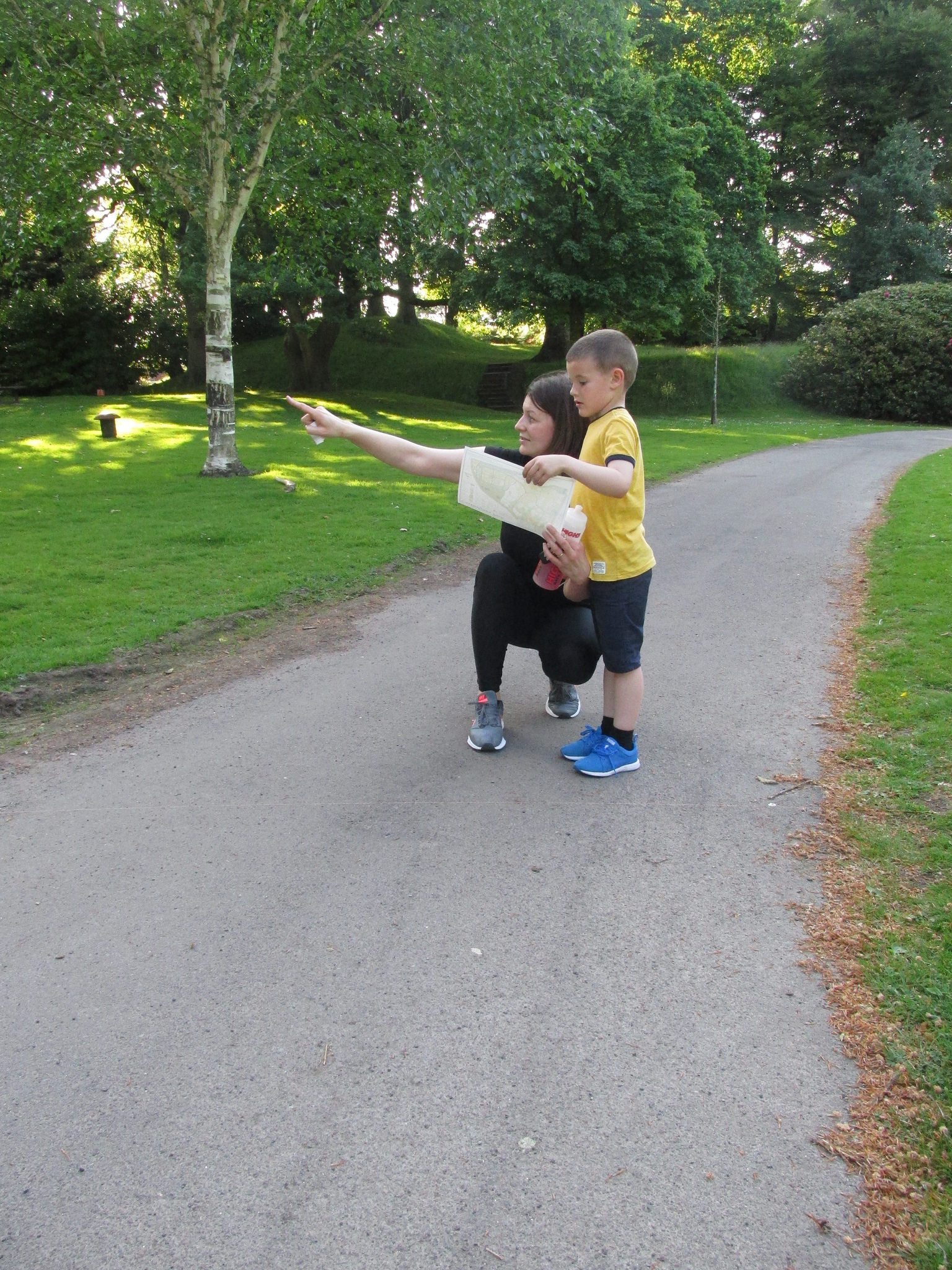
 beginner you’re very welcome at club events. Orienteering activities and events are a great family outdoor activity, great for socialising or keeping fit with friends, for enjoying the outdoors and exploring your local area. Most clubs offer specific activities or events just for beginners. These events help you get to know the basics and increase your confidence.
 Arriving

 There are many ways your local club and the SOA can help get you started with or improve your orienteering techniques.

 Using a detailed map, you navigate a course of “control” points, each of which is marked with an orange and white ‘kite’. There’s no set route between the controls, so you have to decide which way to go and find your way there.
 Most orienteering events offer a range of courses with varying degrees of navigational difficulty, so there’s something to suit all ages and levels of fitness, experience and confidence. The easier courses stick to paths, while the harder ones require more complex navigation and advanced map reading skills. How the courses are graded may vary from event to event, so it’s best to ask one of the event volunteers, who’ll be happy to recommend a course for you to try.
 For individuals and families, the best way to try orienteering is to


